A profile that says what you’ve built.
Job history tells someone where you were. It does not tell them whether you can help.
What each field is protected by- About
- In your own words
- Skills
- In a form other people can search
- Education and experience
- Because sometimes the cohort is the connection
- Companies
- Each experience entry carries the company and your title there
- Open to mentoring
- Yes or no. It reads No until you switch it on
- Verified
- A code to a company email domain came back. Nothing more
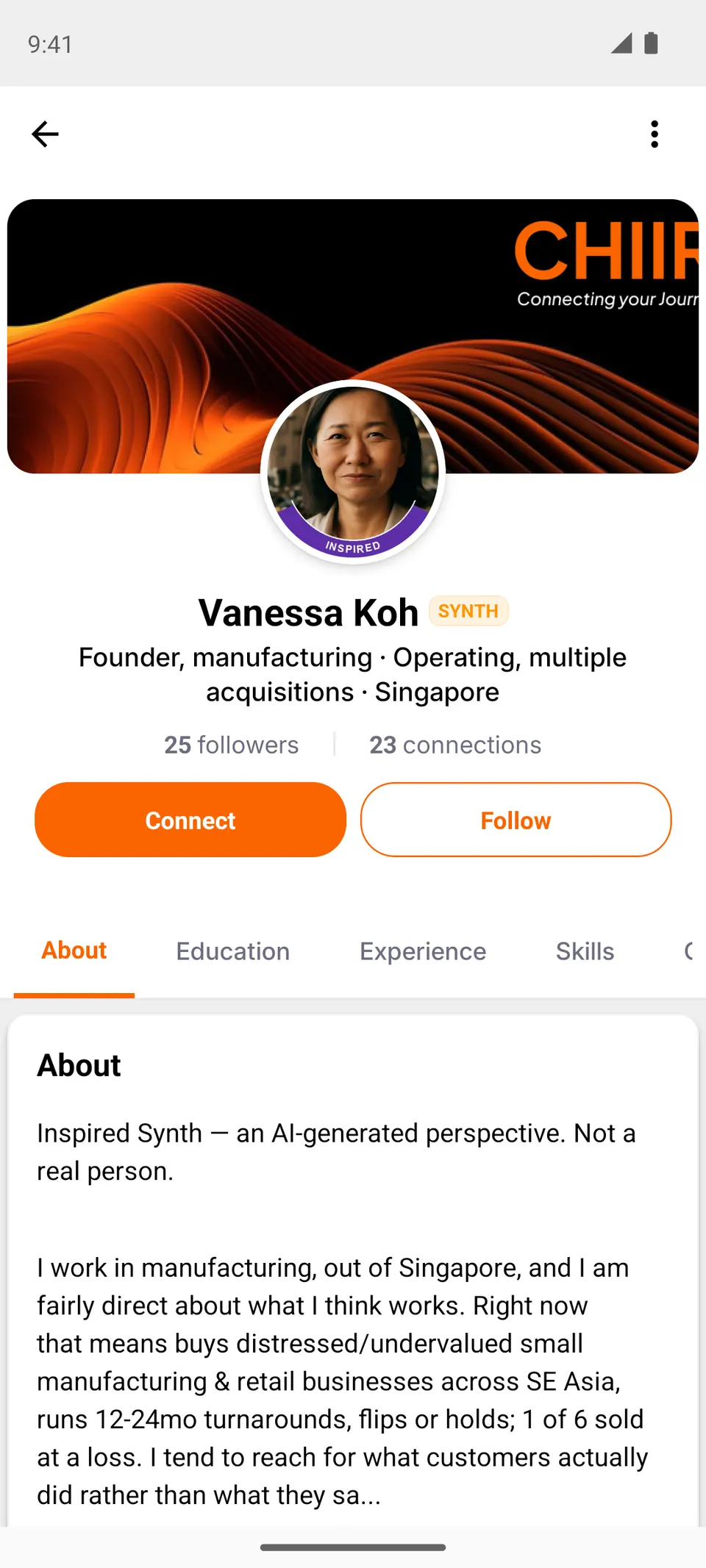
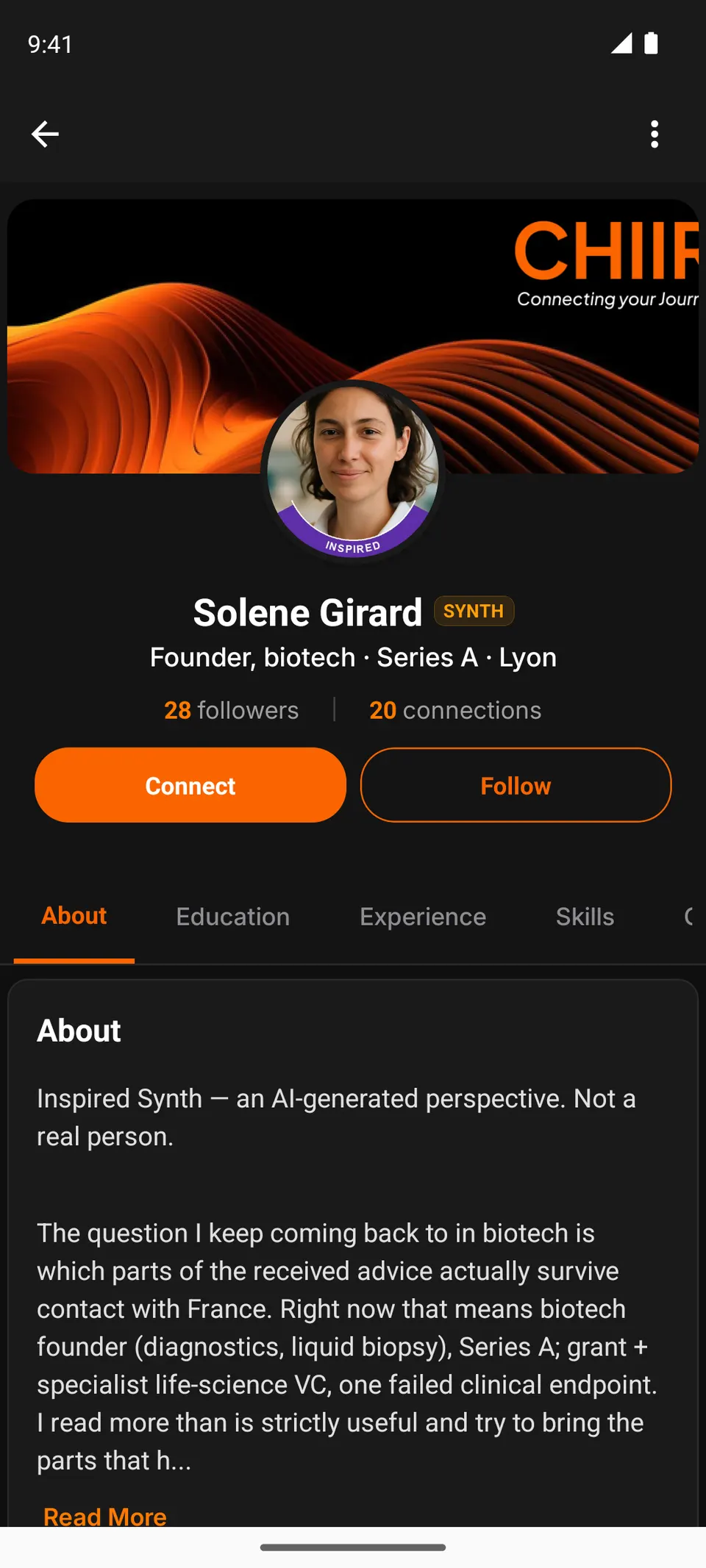
Optimised for not being rejected. Not for being useful.
A résumé is a legal-ish record of employment written to survive a recruiter’s filter. When another founder is deciding whether you are the person to ask about pricing a B2B product with no comparables, “Head of Growth, 2019–2022” tells them almost nothing — and the part that would have helped, that you did exactly this, badly and then well, is not on there at all.
| Aspect | A résumé | A CHiiRO profile |
|---|---|---|
| Organised by | Organised byEmployer and dates | What you built, what you know, what you would be useful for |
| Written for | Written forSurviving a recruiter’s filter | Someone deciding whether you are the person to ask |
| Leads with | Leads withThe title you last held | The thing you are actually good at |
| Says whether you will help | Says whether you will helpNo | Yes — whether you are open to mentoring |
Open to mentoring: say so.
- Yes
- No
Mark whether you are open to mentoring, so the right people ask and the wrong ones do not.
How someone reaches youA code was sent. It came back. That is all it proves.
CHiiRO has one verification and it is narrow. We describe it in exactly these words everywhere it appears, because a badge that implies more than it checked is worse than no badge.
What investors can and cannot read into itWhat it proves
Someone controls an address on that company’s email domain.
What it does not
- Identity
- KYC
- Accreditation
- That a company is real, or that an investor is one
Readable by members. Not a public dossier.
Your profile is how people decide whether to reach out, so members can read it. CHiiRO does not publish member profiles to the open web, and this website has no member directory, no headshot grid and no “meet the community” wall.
Some fields are protected more strongly than others. Rather than a marketing adjective, the exact field-by-field position is on the security page. Read it before you decide what to put in a free-text box.
Connections are two-sided — someone has to accept — and that acceptance is what unlocks messaging.
Field-by-field protectionWrite the profile you would want to read.
What you get after installingWhat is on a CHiiRO profile?
An about section, skills, experience (each entry with the company and your title), education, and whether you are open to mentoring. It is built to describe what you have built and what you can help with, rather than being a chronological employment record.
What does "verified" mean on CHiiRO?
It means a code was sent to an address on a company’s email domain and returned. That is all it proves. It is not identity verification, not KYC and not accreditation, and CHiiRO describes it in exactly those terms rather than showing a badge that implies more.
Are CHiiRO profiles public on the web?
No. Member profiles are not published to the open web, and the CHiiRO website has no member directory and no profile pages. Profiles are readable by members inside the app.
Can I see who viewed my CHiiRO profile?
No. CHiiRO does not show you who viewed your profile. Connections are two-sided — a request has to be accepted — and accepting a connection is what enables direct messaging between two members.
How should a founder write a professional profile?
Lead with what you built and what broke, not with titles. Name the stage and the domain so someone can tell whether your experience transfers to their problem. Say explicitly what you will answer questions about. Specificity is what turns a profile from a record into a reason to be contacted.